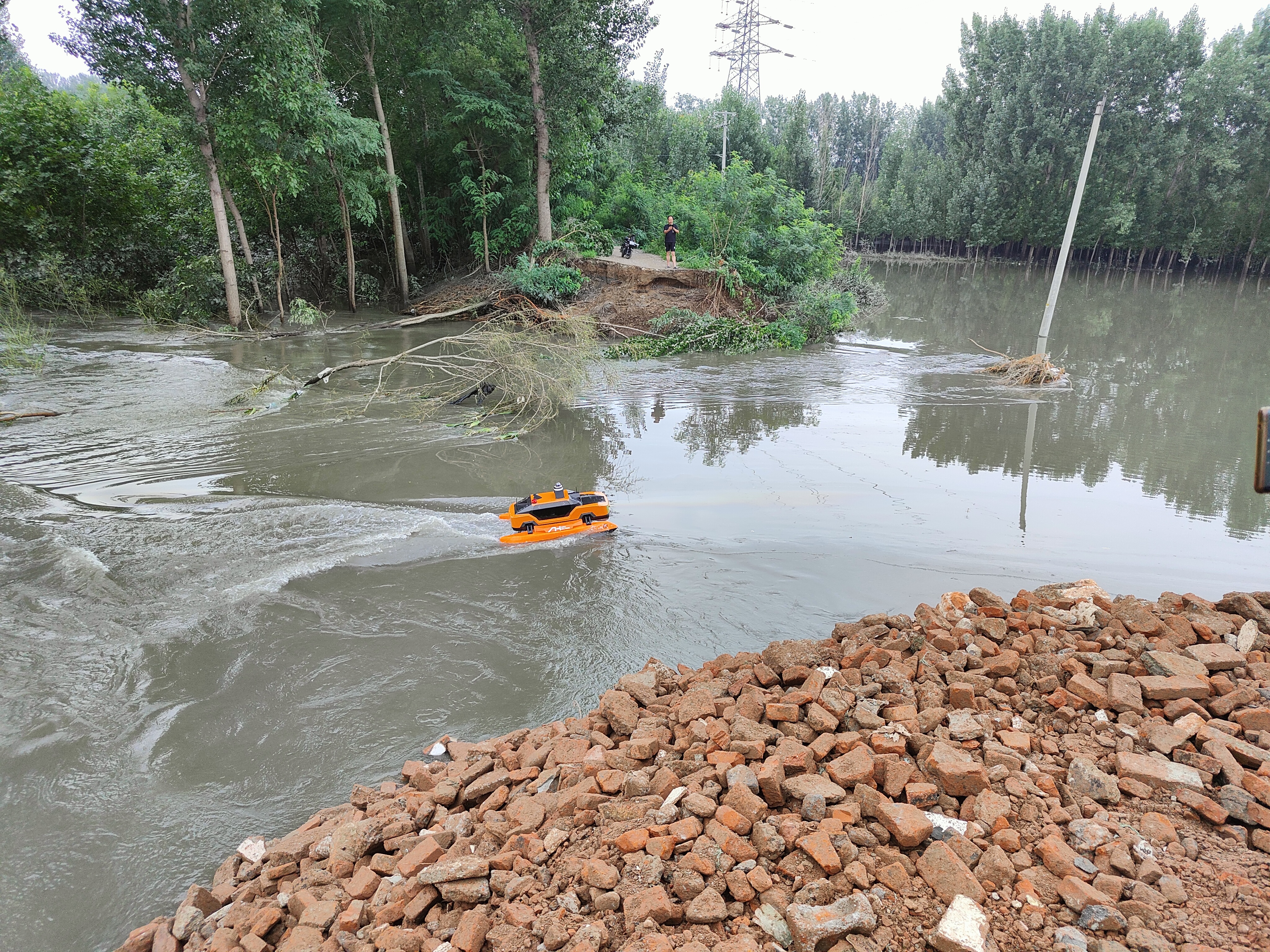
Measuring Flood Flows with USVs: Collecting Discharge Data When the River Is Dangerous
Flood events are exactly when discharge data matters most, and exactly when conventional measurement is least safe. Cableways become hazardous, crewed boats struggle to hold a line in high velocity, and debris moves through the section faster than an operator can react. A USV changes the risk equation, but it does not remove methodological problems. What flood gauging actually demands, and how a USV can be used without compromising data quality, is the subject of this article.
1. Why Flood Flows Are Hard to Measure
Three difficulties arrive together during a flood. Velocity rises well above normal working conditions, large amounts of debris move through the section, and the channel geometry itself changes as bed material is scoured and redeposited. A cross-section that was surveyed last month may no longer describe the river in front of you, and it may change again before the peak passes. At the same time, high suspended sediment concentrations can degrade acoustic bottom tracking, so the reference used to convert measured velocities into a discharge becomes less reliable exactly when the numbers matter most. Measurement windows are also short: a flood peak may last hours, and the section is only stable for part of it.
2. What a USV Changes, and What It Does Not
A USV removes the operator from the vessel, which is the single largest safety gain in flood conditions. Its shallow draft allows work close to the banks, it can be launched from a road or embankment rather than a slipway, and it can hold a predefined line across a section that a crewed boat would struggle to repeat. What it does not change is the measurement itself. The ADCP still needs a correct mounting depth, a stable heading, and a valid reference. Debris still strikes and fouls the hull and transducers, so speed control and physical protection remain necessary. Bank access, radio range, and positioning quality are still constraints, and when velocity or wave height exceeds the platform's rated conditions, the correct decision is not to launch.
3. Planning the Measurement
Section choice matters more in floods than in routine work. A straight, reasonably uniform reach without large eddies gives the cleanest velocities, and returning to the same section used for historical gauging keeps the record comparable. Because discharge changes while the peak passes, a single crossing is rarely enough; several transits are made in succession and the results are averaged, with the time of each pass recorded. The unmeasured margins near the banks and any shallow gaps between lines must be estimated rather than ignored, since their share of total discharge grows as the section widens. Transit speed should be set so the ADCP collects enough ensembles per line, and a recovery plan for the downstream end of the section should be agreed before launch, not after.
4. Reading the Data With Care
Flood data deserves more scrutiny than routine data, not less. Each pass should be checked for bottom-tracking stability against an independent position reference, and for heading and track straightness. Passes that disagree beyond a reasonable margin should be discarded rather than averaged in, and the remaining ones compared for consistency before a discharge value is reported. It is also worth comparing the result with the existing stage-discharge relationship: high-flow points are usually the least constrained part of that curve, so a flood measurement either confirms the extrapolated section or shows where it needs revision. None of this replaces established gauging procedure; it simply gives that procedure a safer way to collect the data.
5. Conclusion
Flood flow measurement is a method problem before it is an equipment problem. A USV makes the work safer and more repeatable by keeping people off the water and holding the section steady, but the value of the result still depends on section choice, repeated transits, honest edge estimates, and disciplined checking. Used that way, a USV does not just replace a risky boat trip; it adds high-flow points to a gauging record that has always been thin exactly where the stakes are highest.