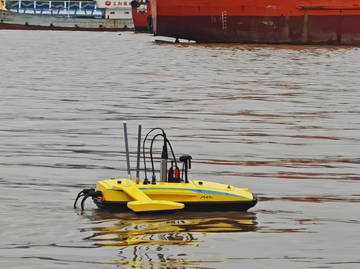
1.From Survey Data to Action: How AI and Cloud Platforms Improve USV Operations
A USV does not create value simply by moving autonomously across the water.
The real value comes from the data collected during the mission and what happens after that data is collected.
As USV systems become more capable, software, cloud platforms, and AI are becoming increasingly important parts of the overall workflow.
2.From Vessel to Data Platform
A traditional survey workflow may look like:
Vessel → Sensor → Data → Office Processing → Report
A connected USV platform can expand this into:
USV → Sensors → Navigation → Data Processing → Cloud Platform → Analysis → Decision
This creates a more connected survey workflow.
3.What Data Can a USV Collect?
Depending on the payload, a USV can collect:
- Position
- Depth
- Water quality
- Current velocity
- Sonar imagery
- Camera imagery
- Environmental measurements
- Vessel status
NOAA lists bathymetry, water temperature, salinity, dissolved oxygen, currents, imagery, and water sampling among the types of information that USVs can collect.
4.Why Cloud Connectivity Matters
When survey data is connected to a cloud platform, users can potentially monitor missions and access results without waiting for the vessel to return to the office.
A cloud-based system can support:
- Mission monitoring
- Data storage
- Remote access
- Project management
- Map visualization
- Historical comparison
- Multi-user collaboration
5.Where AI Can Help
AI does not necessarily replace the survey sensor.
Instead, it can help process and interpret the information collected by the system.
Potential applications include:
- Object detection from sonar imagery
- Image classification
- Anomaly detection
- Route optimization
- Data quality checks
- Automated reporting
- Predictive maintenance
For example, a side scan sonar survey may generate a large amount of underwater imagery. AI-based processing could help identify areas that require closer inspection.
6.AI + Autonomous Navigation
AI can also support the navigation side of a USV.
Future autonomous systems may increasingly combine:
Perception → Decision → Navigation → Action
The vessel can use sensor information to understand its environment and adjust its behavior according to predefined mission rules.
Research into USV systems is already exploring more advanced autonomous behaviors, including risk-aware path planning and navigation in environments where GNSS signals may be degraded.
7.Why the Full System Matters
For end users, buying a USV is only one part of the project.
The complete solution may include:
- USV hardware
- Sensors
- Navigation software
- Communication system
- Cloud platform
- Data processing
- AI algorithms
- Technical support
This is particularly important for engineering companies and system integrators that want to deploy USVs as part of a larger operational workflow.
8.Conclusion
The development of USVs is moving beyond autonomous vessel control.
The next stage is the integration of hardware, sensors, software, cloud platforms, and AI into one connected system.
For survey and environmental applications, this means the focus can shift from simply collecting more data to turning that data into useful information for engineering and operational decisions.