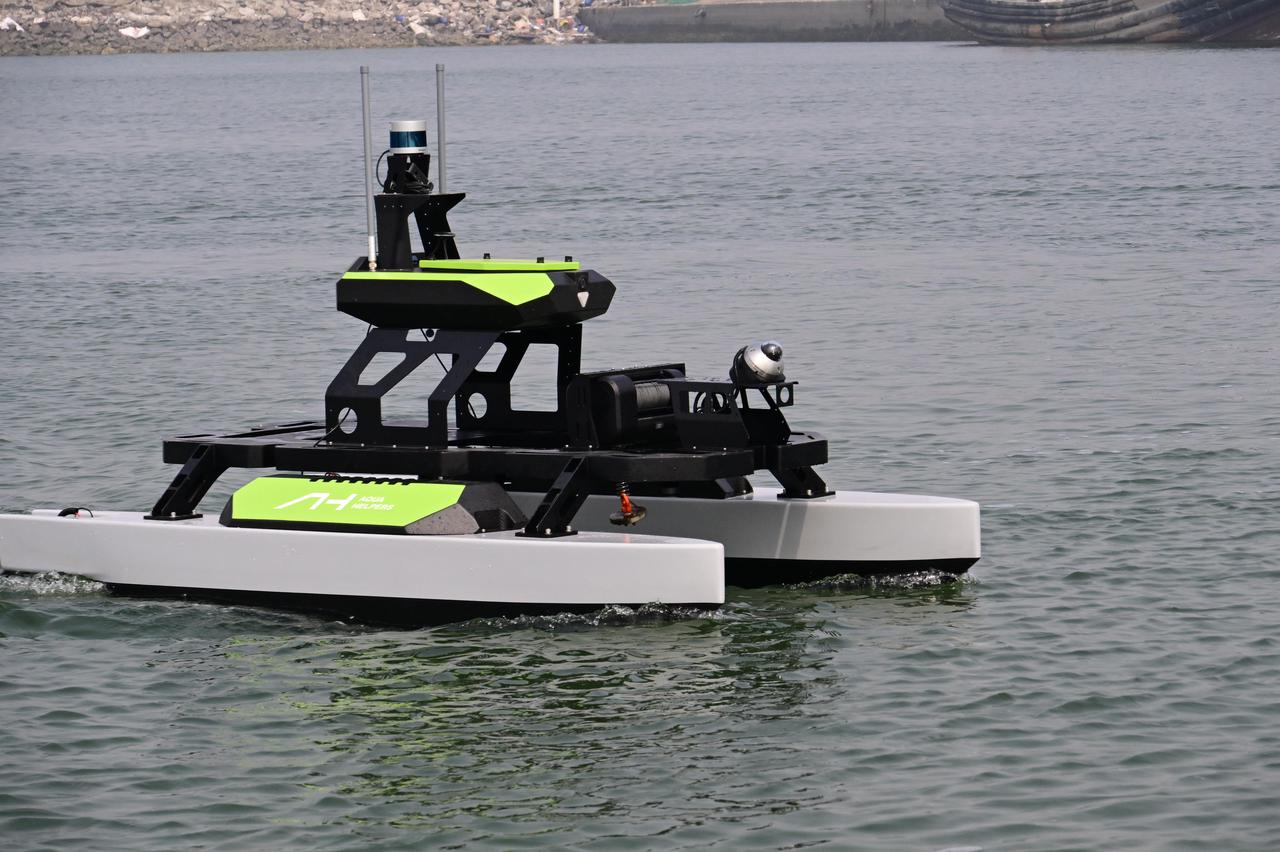
Traditional survey boats have been widely used for hydrographic surveying for decades. However, the development of Unmanned Surface Vessels (USVs) has introduced a new option for collecting bathymetric and environmental data. Both platforms have their advantages, and the better choice depends on the survey environment, payload requirements, operating area, and project objectives.
1.USV and Traditional Survey Boat: What Is the Difference?
The most obvious difference is that a traditional survey boat requires personnel onboard, while a USV is designed to operate without a crew. A USV can be remotely controlled or programmed to follow predefined survey routes, allowing operators to monitor the mission from shore.
For bathymetric surveys, both platforms can carry professional equipment such as single-beam and multibeam echosounders. USVs can also integrate ADCPs, water quality sensors, side-scan sonar, and other payloads. Therefore, the key difference is not necessarily the survey equipment, but how the vessel is operated and deployed.
2.When Does a USV Have an Advantage?
USVs can be particularly effective for shallow-water and confined-area surveys. Rivers, canals, reservoirs, lakes, and port areas may have limited space or water depth for conventional survey boats. A compact USV can access these environments more easily while collecting survey data along predefined routes.
Autonomous navigation is another major advantage. Instead of manually steering the vessel throughout the entire survey, operators can create a mission in advance and allow the USV to follow the planned survey lines. This can be especially useful for large numbers of repetitive survey lines or projects that require regular monitoring.
USVs can also reduce the need for personnel to work directly on the water. While operators still need to monitor the mission and respond when necessary, remote operation can make certain survey tasks safer and more efficient.
3.When Is a Traditional Survey Boat Still the Better Choice?
A conventional survey boat may still be preferable for large-scale offshore operations, heavy payloads, or missions requiring multiple personnel and extensive equipment onboard. Larger boats generally provide greater payload capacity and space for additional systems.
For this reason, choosing between a USV and a traditional survey boat should start with the actual project requirements rather than simply comparing the two vessel types. Survey teams should consider water conditions, survey area, payload, endurance, communication range, positioning accuracy, and operational requirements.
USVs are not replacing traditional survey boats in every application. Instead, they provide a more flexible option for many modern hydrographic surveying projects, particularly where autonomous navigation, shallow-water access, and remote operation are important.