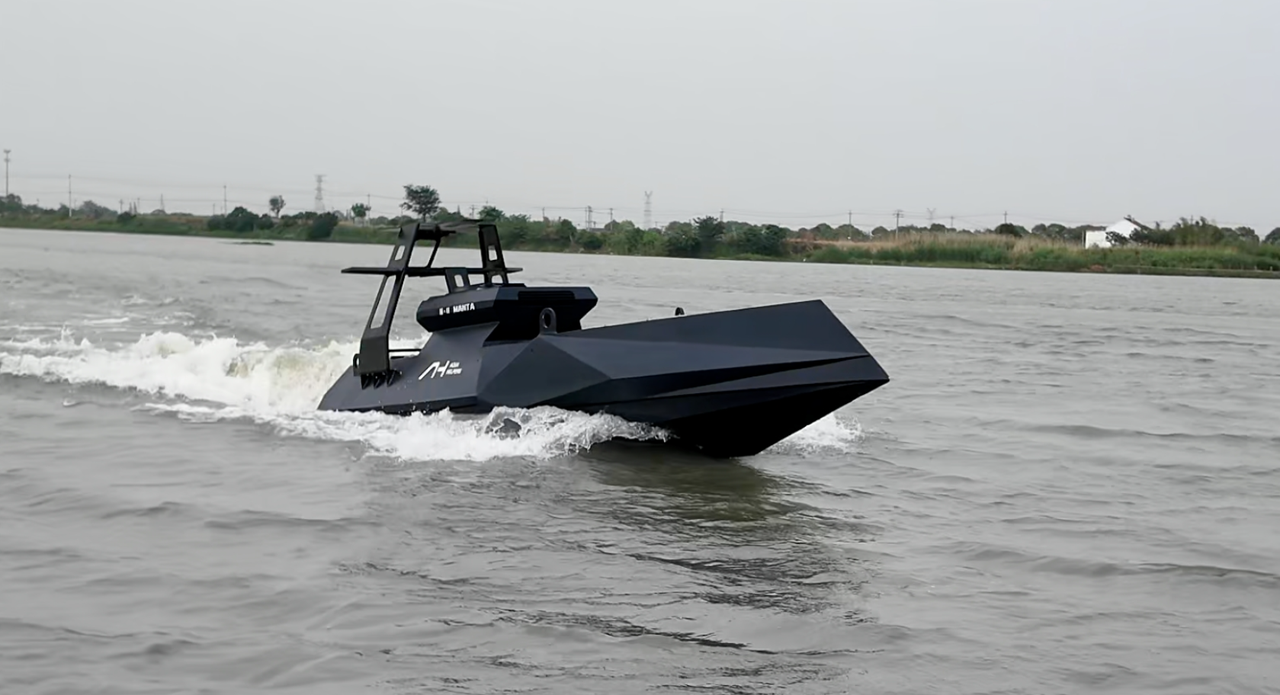
1.The future of naval operations
As autonomous technologies continue to advance, navies around the world are exploring new ways to integrate unmanned systems into maritime operations. Rather than relying solely on traditional warships, many defense organizations are investing in fleets of autonomous platforms that can work alongside crewed vessels to improve surveillance, reconnaissance, and mission efficiency.
A recent concept demonstration conducted by the Royal Navy provides a clear example of this evolving approach. During a 72-hour trial, five unmanned surface vessels (USVs) operated as a coordinated swarm, continuously tracking and monitoring naval targets. The exercise was designed not only to evaluate the performance of the autonomous vessels, but also to examine how unmanned systems could become an integral part of future naval operations.
The trial centered around the Royal Navy's vision of a "Hybrid Navy," where crewed ships, unmanned surface vessels, autonomous underwater vehicles, and unmanned aerial systems operate together as a unified force. By combining multiple autonomous platforms with conventional naval assets, future fleets could achieve greater operational flexibility while reducing the burden on high-value warships.
2.Application in the real world
The unmanned platform used during the demonstration, known as Rattler, is based on a seven-meter rigid inflatable boat equipped with autonomous navigation capabilities and a range of onboard sensors. During the exercise, multiple Rattler vessels worked together to maintain continuous surveillance of designated targets. Cameras and sensors collected real-time information, which was transmitted back to operators through remote communication systems.
Several Royal Navy vessels participated in the demonstration, with HMS Tyne and HMS Stirling Castle acting as simulated foreign naval ships that required continuous monitoring. The exercise demonstrated that autonomous surface vessels could effectively perform routine maritime surveillance tasks, allowing larger and more expensive warships to focus on missions that require greater operational capability.
One of the most significant achievements of the trial was the successful demonstration of long-distance remote operations. While the autonomous vessels operated in waters near Scotland, mission operators remained at HMNB Portsmouth in southern England, approximately 500 miles away. Despite the distance, operators were able to receive live sensor data, monitor vessel activities, and oversee mission execution through secure communication networks.
This capability highlights the growing importance of networked autonomous systems. Future maritime operations may no longer require personnel to be physically located near the operational area. Instead, centralized command centers could supervise multiple autonomous platforms deployed across different regions, improving responsiveness while reducing operational risks.
Although the current system still relies on human supervision, the long-term objective is to enable higher levels of autonomy. Mission plans, navigation routes, patrol areas, and coordination strategies can be defined before deployment, allowing multiple USVs to cooperate with minimal human intervention. Operating together as an intelligent swarm, autonomous vessels can share information, distribute tasks, and adapt to changing operational conditions more efficiently than individual platforms working alone.
3.The advantages of swarm operations
Swarm operations also offer significant strategic advantages. Instead of depending on a single high-value asset, multiple lower-cost autonomous vessels can form a distributed maritime surveillance network. Each platform contributes information to the overall mission while maintaining the flexibility to perform independent tasks. This distributed approach enhances resilience, expands operational coverage, and reduces the impact of losing any individual platform.
The Royal Navy's demonstration reflects a broader global trend in naval modernization. Defense organizations worldwide are investing in unmanned surface vessels, autonomous underwater vehicles, and unmanned aerial systems to strengthen maritime awareness and improve operational efficiency. As these technologies continue to mature, autonomous platforms are expected to assume an increasingly important role in surveillance, reconnaissance, mine countermeasures, offshore security, and other complex maritime missions.
Rather than replacing conventional warships, autonomous systems are likely to complement them, creating more flexible and capable naval forces. The concept of a hybrid fleet demonstrates how crewed and uncrewed platforms can work together to deliver greater operational effectiveness while reducing costs and expanding mission capabilities.
As swarm intelligence, autonomous navigation, and remote command technologies continue to evolve, coordinated unmanned systems may become one of the defining features of next-generation naval operations. The Royal Navy's recent exercise illustrates that this future is no longer a distant concept but an active area of development, with autonomous maritime technologies steadily transforming the way naval missions are planned and executed.