I. Over 90% of the cost of a premium sonar system stems from three core components
1.1 Transducer Arrays: Far more than simple underwater speakers
Transducers and acoustic arrays constitute the priciest hardware segment.
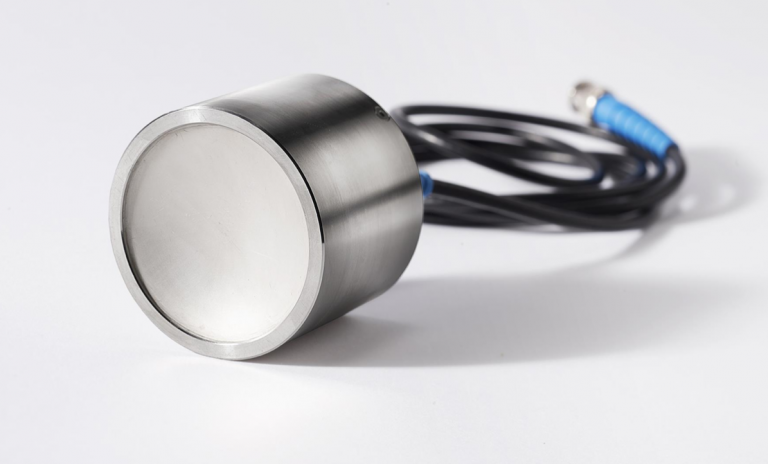
'Heart' of sonar system — piezoelectric ceramic ultrasonic transducer
PZT piezoelectric ceramics are widely adopted mainstream materials. Whereas, for high-end sonar devices demanding superior sensitivity and wider bandwidth, relaxor ferroelectric single crystals (e.g., PMN-PT) have become the preferred alternative. These crystals require lengthy growth cycles and suffer from low finished product yields, making them vastly more expensive than ordinary ceramics. A single tiny crystal wafer can cost dozens of US dollars, while one array requires hundreds or even thousands of such wafers.
Moreover, high-performance sonar does not rely on a single transducer; instead, it employs arrays composed of hundreds to thousands of array elements, such as spherical arrays on submarines and towed linear arrays. Every element must feature highly consistent resonant frequency, impedance and sensitivity after processing. Mass rejection during screening and matching drastically inflates costs.
For instance, a towed linear array sonar hundreds of meters long may integrate thousands of hydrophone channels. The manufacturing, matching and integration of these precision sensors alone account for 30% to 50% of the total system cost.
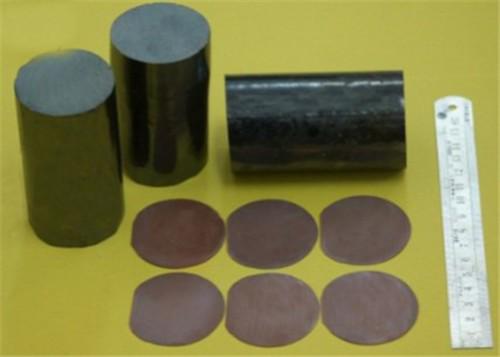
Relaxor ferroelectric single crystals
1.2 Electronic Channels: A dedicated neural circuit for every underwater sensor
Each of the thousand ceramic "acoustic sensors" needs a dedicated high-grade electronic channel, including amplifiers and analog-to-digital converters.
Each channel must deliver two contradictory capabilities simultaneously: detecting extremely faint distant acoustic signals (like a needle dropping far away underwater) while resisting saturation from intense nearby interference. High-dynamic-range electronic channels come with steep individual costs, and the total expense surges when multiplied by hundreds or thousands of channels.
Subsequently, thousands of signal streams converge to undergo real-time, computationally intensive beamforming algorithms, enabling the sonar to achieve full 360° omnidirectional detection. This requires clusters of top-tier FPGA chips for continuous computation, with hardware and thermal management adding substantial extra costs.
1.3 R&D and Testing: Hidden costs of algorithms and deep-sea trials
The above items are tangible hardware expenses; the true core value lies in intangible assets.
Seawater is an uneven medium that refracts sound waves and generates heavy reverberation clutter. Algorithms capable of adapting dynamically to marine environments and distinguishing submarine propeller signatures from fish noise represent decades of cumulative expertise from underwater acoustics specialists—an enormous investment in intellectual property.
Finished sonar hardware cannot be directly deployed on vessels; repeated testing in deep lakes or open-sea test zones is mandatory. Chartering a research vessel costs hundreds of thousands of US dollars per day. Destructive tests such as shock resistance evaluation often write off entire expensive prototype units.
These three major cost drivers explain why cutting-edge military sonar systems can sell for tens of millions of US dollars.
II. Practical Cost Reduction Strategies
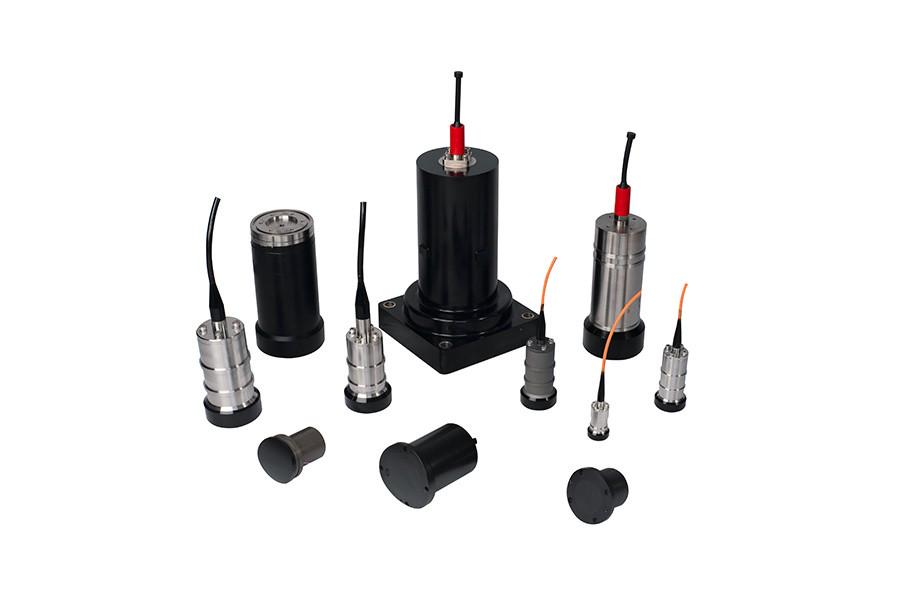
Transducers of sonar system
2.1 Modular Hardware Design to Eliminate Redundant Expenses
Traditional sonar systems feature custom hardware architectures for every model, requiring full redesign from scratch. Hardware cost reduction centers on splitting sonar systems into independent functional modules: transducer arrays, signal processing units, power management modules and data interfaces, all equipped with unified standardized mechanical and electrical connectors.
- Standardized components for higher universality: Unify physical dimensions, supply voltages, communication protocols and mounting hole positions. Modules can be freely reused across different product lines, eliminating custom mold opening and separate material stocking for individual models.
- Complete supporting ecosystem: Similar to Lego blocks, standardized modules come with comprehensive adapters, connectors and mounting fixtures, allowing customers to rapidly integrate the system onto their platforms.
Therefore, material categories are drastically streamlined, bulk purchasing of individual components drives down unit prices, and interchangeable modules simplify spare parts inventory for after-sales support.
2.2 Software Compensation to Offset Hardware Tradeoffs
Hardware standardization inevitably compromises extreme performance for niche use cases. Software and algorithms bridge this performance gap.
Adaptive filtering and beam optimization algorithms deliver advanced beamforming and sidelobe suppression for generic wideband arrays, removing the need for custom-tuned transducers.
Synthetic aperture algorithms and AI super-resolution reconstruction boost imaging resolution.
Deep learning enables environment-adaptive noise reduction and target enhancement for varying underwater noise profiles.
The core logic of software optimization is shifting costs from custom hardware manufacturing to replicable, iterable algorithms. Standardized hardware is mass-produced once, while software performance receives continuous upgrades.
2.3 Business Model Transformation: Standardized Hardware with Software-Defined Functionality
Once hardware is developed as standardized off-the-shelf modules, the business model undergoes a fundamental shift.
The same set of modular hardware can be configured for diverse applications via distinct software packages: For example, high-precision imaging mode for hydrographic survey and scientific research, fish detection and tracking mode for fisheries, forward-looking collision avoidance and underwater communication mode for emergency rescue
Additional optimization measures include outsourced manufacturing of standard modules and unified shared testing platforms to accelerate technical iteration.
An open developer ecosystem can be built on standardized interfaces: we provide a unified underwater acoustic hardware platform (analogous to iOS), while third-party developers design specialized application algorithms (analogous to mobile apps).
For end customers, the value proposition is clear: affordable mass-produced standard hardware, flexible software-defined functionality, and easy upgrades via interchangeable modules and iterative software updates.
Once this model matures, competitive advantages no longer rest on single high-specification products, but on a low-cost hardware platform, continuously evolving algorithm ecosystem, and modular product matrix. Cost-effectiveness means accessing upgradable underwater acoustic capabilities at a lower total cost of ownership.
2.4 Ultimate Cost Reduction Lever: Mass Production and Military-Civilian Integration
Technical optimization can only flatten the cost curve; scaling production is the only way to slash prices from tens of millions to tens of thousands of US dollars.
Military-grade sonar technology can be adapted for mass civilian applications, including subsea pipeline leak monitoring and marine aquaculture fish stock detection. Boosting output from a handful of military units to thousands of civilian devices dilutes R&D and manufacturing overhead significantly—this is the most powerful cost-cutting commercial strategy.
III. Conclusion
The high price tag of advanced sonar reflects the extreme engineering challenges involved in underwater acoustic detection. Cost reduction does not aim to produce low-end cheap equipment, but rather leverages optimized design tradeoffs and technology transfer to make underwater acoustic sensing accessible to a broader range of industries.
When MEMS technology and mass manufacturing bring high-performance hydrophones to affordable price points, humanity's capacity to perceive the ocean will evolve from passive acoustic listening to full underwater optical-acoustic imaging.